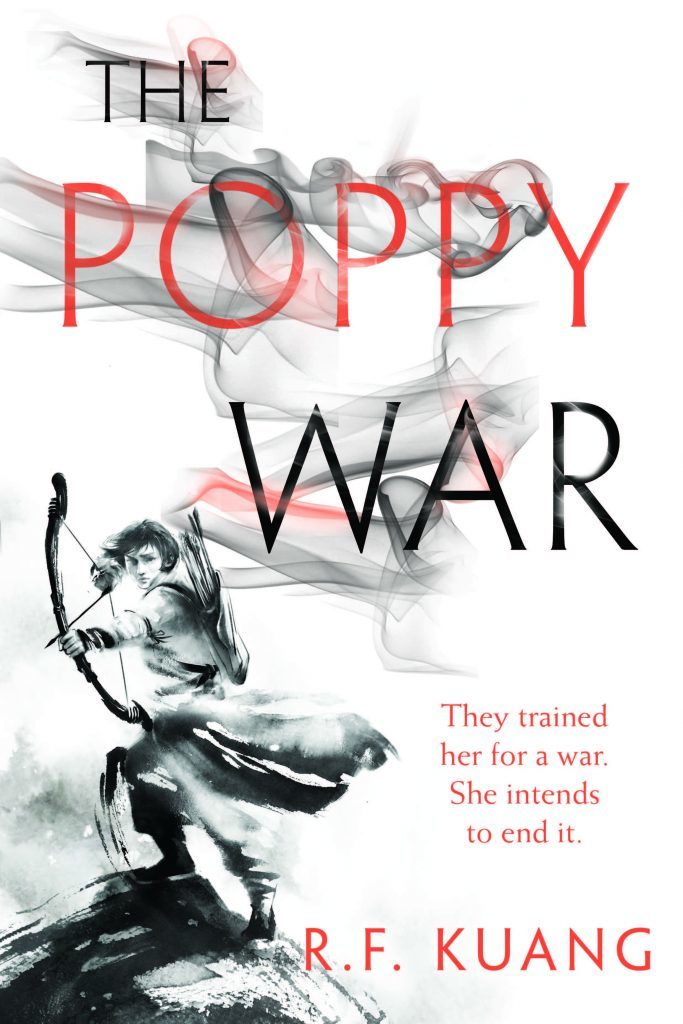
Author: R.F. Kuang
Publication Date: 2018
Genre: Fantasy
Number of Pages: 545
Geographical Setting: Nikan (fictional country)
Time Period: The Third Poppy War (equivalent to the Second Sino-Japanese War)
Series: The Poppy War #1 (trilogy)
Plot Summary: Fang Runin, "Rin," was not supposed to amount to much. She's a war orphan from a backwater village in Rooster Province, one of the unimpressive Southern territories that make up the massive Nikara Empire. Her prospects are limited - continue running opium for her cruel guardians, or allow the matchmaker to marry her off to an old man. Instead, she risks everything to take the Keju - an academy entrance exam given to promising teenagers in all of the Provinces - and gets the highest marks in her territory. Her score qualifies her to attend the military academy Sinegard, the most elite of the schools. Sinegard is an escape from the drudgery of her previous life, but it is not without its own set of difficulties. Her peers and instructors harshly discriminate against her on the basis of her Southern heritage. Her workload is stifling, barely giving her time to sleep or eat between studying military history, tactics, lore, and weapon training. Rising political tensions between Nikan and their oppressive neighbors, the Federation of Mugen, threaten the start of a war that would inevitably land on the shoulders of Rin and her classmates. And most frighteningly, in the back of her mind, Rin can feel a power awakening - a power that wants to burn down the entire world.
Subject Headings:
Goddesses -- Fiction.
Imaginary wars and battles -- Fiction.
Magic -- Fiction.
Military education -- Fiction.
Shamans -- Fiction.
Appeals:
- Building pace: The book begins before Rin enters the academy, and it takes a while for her to even get to that point. Once she's there, we spend the majority of the novel learning about the world, the history of Nikan, and the personalities of the students and teachers at Sinegard. There are entire chapters where the only things that happen are a meditation session, or a trip to a library, or the details of cultural festival. Readers get full situated in the world and in the characters' lives before the action picks up - but once it does, the pacing shifts to something more similar to an adventure novel full of extremely violent battles and desperate fights.
- Well-defined setting and frame: Wyatt & Saricks describe fantasy as "a genre of abundance - of creative ideas, lavish description, and telling details" (2019, p. 125). R.F. Kuang clearly dedicated time and thought to her fantasy setting, deftly weaving together shamanistic religions and traditions with powerful magic, drawing on the history of pre-industrial China as well as the horrific events of the Second Sino-Japanese War. The setting and frame of the story are just as important as the characters or the plot - it isn't a story that could happen anywhere else. This is an epic fantasy, complete with maps, deep history, and a detailed description of a magical system.
- Grimdark tone: This is not a happy book. There are realistic depictions of violence, of racism, poverty, war, and genocide. Like the Dark fantasy novels described by Wyatt & Saricks, "they are stories filtered through a grim, violent, and gritty worldview" (p. 127). Our protagonist is the victim of a lot of this grimness, but she deals out her fair share of atrocities as well, creating a complex feedback loop where death begets more death and morality becomes something much murkier than black-and-white. One chapter in particular, based on the real WWII Massacre of Nanjing, is excruciating to read.
- A long, rich story: Standing alone, The Poppy War is a long read - almost 550 pages - but it is also the first book in a trilogy, and the subsequent books are equally long. They tell a continuous story, spanning years - from peacetime into foreign war, from foreign war into civil war, and from civil war into the start of an Industrial revolution. The characters, story, and setting get plenty of room to grow and become elaborate, and readers are rewarded for their patience after a slow-paced start by getting to spend their time in an intricately-developed world.
Terms that best describe this book: Grimdark, Asian-influenced military fantasy, world-building
Relevant Fiction Works and Authors:
- Jade City by Fonda Lee: Both novels are the first books of series that take place in East Asia-inspired fantasy settings on the brink of war. Other appeals shared between the two are the epic story, the descriptive world-building, the compelling and large cast of characters, and the "own voices" tone. However, while The Poppy War centers on characters who are in the military or in military academies, Jade City revolves around a criminal syndicate.
- Daughter of the Moon Goddess by Sue Lynn Tan: This book is YA, and so it doesn't have the same amount of grim violence present in The Poppy War; instead, the tone leans more towards romantic and enchanting. But both books are descriptive, detailed, and draw their inspiration from Chinese mythology. In fact, the story of the Moon Goddess is one that features briefly in Rin's spiritual education and history lessons in The Poppy War.
- Iron Widow by Xiran Jay Zhao: While this novel leans more towards sci-fi than fantasy, the main character of the series is similar to Rin: vengeful, prone to violence, and with frighteningly loose control over deadly psychic abilities. Common appeals are a strong female protagonist, a military/war-torn dystopic setting, and a grim/gritty tone.
Relevant Non-Fiction Works and Authors:
- Illustrated Myths & Legends of China: The Ages of Chaos and Heroes by Dehai Huang, Xiang Jing, and Zhang Dinghao: The magic that exists in the world of The Poppy War is directly linked to a pantheon of 64 shamanistic gods, who are either heavily inspired by or directly taken from Chinese mythology. This illustrated guide gives background on the creation myths and the powerful deities that flavor the world created by R.F. Kuang.
- Mao: A Biography by Ross Terrill: Mao Zedong might be one of the most polarizing historical figures of all time; he is also the basis for the character of Rin, an equally complex personality capable of creation and destruction. Understanding Mao's rise to power and what he does once he gets there is to get a glimpse into the motivations and worldview of Fang Runin. And many other characters in The Poppy War are inspired by Mao's real-life allies and rivals - fans of the series might find it fun to try to figure out who is who.
- Forgotten Ally: China's World War II, 1937-1945 by Rana Mitter: the European front of World War II is a topic covered heavily in the American education system, but the Chinese front of the war is less well-known in the West despite the fact that 4 million soldiers and 20 million civilians died as a result of Japan's invasion. Many battles in The Poppy War have direct historical counterparts taken from the Second Sino-Japanese War, and the gruesome genocide, chemical warfare, and human experiments that occur in the novel are essentially non-fiction lifted directly from some of the darkest moments in human history.
Relevant Multimedia tie-ins:
- The Shadow (movie): This is a 2018 Chinese wuxia movie about two rival kingdoms, the fates of which rest on a cruel king and his calculating general, an intricate plot involving look-alike warriors, and a lot of court intrigue. Like The Poppy War, the film is a fantastical retelling of Chinese history, and contains plenty of violent battles and stunningly choreographed fight sequences.
- The Chinese History Podcast (podcast): The contributors of this podcast are Chinese history PhD students, and it covers everything from ancient histories to breaking down modern/current events. If you find yourself fascinated by Rin's world and are curious as to what the past of Nikan might have been, and what it's future may be after the end of the trilogy, this podcast is a treasure trove of knowledge.
- Scythe (board game): Scythe is an engine-building game, and draws inspiration for its setting from alternate history - in this case, a 1920s with some steampunk elements. There are factions based on Eastern European countries, and each player controls one, urging their civilization onward to conquer territory, build up their villages and population. and develop technology. Similarly to The Poppy War, military conflict is a necessity born of nations' need to grow and their desire to protect their own at the expense of everyone else.
- Shadow and Bone (tv series): Alina Starkov, like Fang Runin, is an orphan who has joined the military out of necessity, and who is constantly overlooked due to her background of poverty and her race (unlike the books the show is based on, the show's Alina is half-Shu). Both women rise to power in the ranks after displaying magical aptitude, and struggle with the awesome responsibility that comes with becoming a nation's savior-figure. Another shared appeal is the slightest hint of a romance between the protagonist and tortured antagonist.
- God of War (video game series): [SPOILER!!!] Rin's mystical power in the novel is a gift and a curse from the Phoenix God; she is a conduit for one of the Pantheon to enact its will on the mortal plane. And its will is to burn, to destroy. In God of War, players control Kratos, a Spartan warrior who becomes the Greek god of war through tragic circumstances. Both works are violent, grim reimaginings of mythology and of the gods, and both look back to the history of civilizations with modern eyes.

I too read an R.F. Kuang book! I read "Babel," which seems to be set right before "The Poppy Wars" and largely concerns it's self with the long lasting effects of Imperialism. Such as plundering languages and getting those in Canton (China) addicted to opium.
ReplyDeleteAfter the long winded wind up in "Babel," I am hesitant to read another of Kuang's books (much to the displeasure of my friends).
See, I love the wind up more than the action in most books so I think these appeal to me a lot. That's why fantasy is probably my favorite genre. 500+ pages of world building? Yes please.
DeleteI want to start my response by discussing the importance of Kuang’s work in terms of making the main character in a fantasy novel non-white and non-male; this decision contradicts the stereotypical portrayal of the ‘hero’ as a white male, which is, for females, people who exist outside the gender binary, and people of color, limiting. Furthermore, Rin’s decision to pursue education over marriage highlights the importance of female empowerment and autonomy within the novel.
ReplyDeleteThat the author included shamanistic religions is intriguing. Generally, the only religions depicted are those deemed the majority – the most commonly represented being Christianity and Judaism. History is admittedly not my strength. Therefore, I know little about the history of Japan or the Sino-Japanese War. From The Poppy War, the information Kuang provides, or any previous knowledge you brought to the reading, was religion, particularly shamanism, important in terms of the impetus of the war or during the time of the fighting? If not, do you know why the author chose to include it?
Speaking to your suggested read-alikes, one aspect I thought was interesting was that you included two books that cover Chinese mythology, Daughter of the Moon Goddess and Illustrated Myths and Legends of China because they provide additional information and understanding of the importance of this mythology in The Poppy War. I also appreciated that you included a biography of Mao Zedong. From your analysis of the similarities between Rin and Mao, it seems this background is imperative for the reader to understand the impact of such a prolific figure in Chinese history.
I know Kuang wanted everything rooted in Chinese culture as much as possible, so the "magical" practices - communing with the deities, often through the use of psychoactive drugs - came directly from ancient traditions from Buddhism and Taoism. In The Poppy War, as in real life, China (Nikan) and Japan (Mugen) both had a variety of spiritual practices but not really a national religious identity. The next two books in the series deal largely with a third empire - Hesperia - that acts as a bit of a combination of the British Empire and America. They worship a "Maker" and offer Nikan technological advancement and military support, but their true goal is to "civilize" the East and convert the "lesser" people to the One True religion. Which did happen a lot during the time period the books are based on - from the British purposefully introducing opium to missionaries building churches all over the countryside. In 1949, under Mao, the missionaries were expelled and proselytizing is still illegal in China.
DeleteClaire,
ReplyDeleteI just referenced this book in my special topics paper about hopepunk (antithesis to grimdark). Did you enjoy this book? If so, do you read a lot of "grimdark" books or do you prefer something a little more optimistic?
I really enjoyed this book! I don't read a lot of grimdark, but we have a RPG group that's working through a weird-West Mörk Borg campaign right now that's extremely grimdark and I'm also loving that.
DeleteOMG!! I just noticed we did our fantasy annotation on the same book, that is so cool. I have never read a fantasy book like this before and I absolutely loved it. I am currently on the second book of the series, have you finished this series yet? I would love to hear your thoughts! :)
ReplyDeleteI finished the series this weekend! It's been a long, long time since I've read a series that quickly. Honestly probably since high school. I was blown away. Let me know what you think when you get to the end! I feel like I need to start a support group, it was such an intense emotional ride.
DeleteFantastic annotation! The appeals really add to the summary and the readalikes and other tie ins sound amazing. As always great work and full points!
ReplyDelete